Why the Fediverse should thrive
Basel Punkt Social is a project that aims to make the Fediverse thrive. Why is this important?
A very short history of Social Media Link to heading
In the 2000’s, social media platforms made people around the world discover the joy and value of sharing jokes, events, songs, images, and opinions online. People connected with old friends who lived in remote places, groups of like-minded people organized themselves, and we all got to interact with people who are different from us.
It is painful to see how online places that used to be fun and personal, nowadays offer detached timelines filled with content that that is selected for drawing our attention only. As it turns out, our attention is best kept by content that makes us angry or envious.
It is equally painful to view the current social media landscape in the light of the promise of democratization that was carried in the rise of social media: Every suppressed minority and individual was given a voice. Today, we see that Big Tech companies who own our social media shamelessly sides with power, poisoning the public discourse.
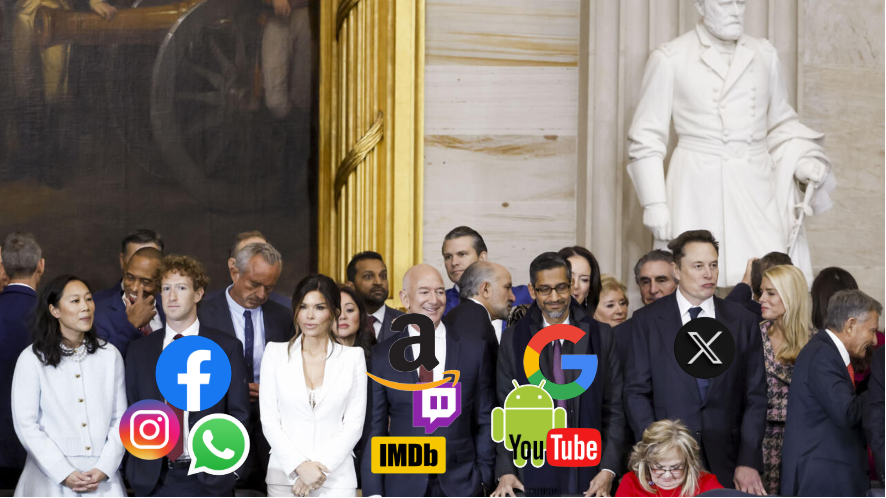
Big Tech CEOs at Trump’s inauguration
Ever more people are aware that the attention-based business model that underlies the design choices of Big Tech social media harms our mental health and democracies. So how can we break this business model? The best way to do so to give people the freedom to choose, and to move without missing out. This freedom is offered in the Fediverse.
The Fediverse breaks the code Link to heading
The “Fediverse” is the term we use to describe the open social web as a federated universe. A longer introduction into the Fediverse is here, but the crucial part is: it’s federated. This property means that the Fediverse is not just a single alternative to Facebook, Twitter, Youtube, or TikTok. It is not another /fenced garden/ that locks users into their niche-monopoly. Instead, the Fediverse is a network of many diverse platforms, that simply speak the same language: an open standard.
The freedom to choose and to move knocks the ad-based business model out of Big Tech’s hands: When people are free to move, who would stay on a platform with creepy tracking habits that serve you feeds packed with advertisements, AI slop and misinformation?
So, if the Fediverse promises healthy and fun social media again, it must be thriving, right?
The Fediverse does not thrive yet 1 Link to heading
Sadly, it doesn’t yet. Relatively speaking, very few people are in the Fediverse. As of 2026, a million users were actively participating in the Fediverse according to the Fediverse Observer 2. This number is large enough to make the Fediverse be a lively, fun and creative place. At a societal level, however, this number is tiny. If we consider that Facebook, Twitter, Linkedin and TikTok together serve over 5 billion active accounts3, only one in every 5000 social media users is in the Fediverse.
The Fediverse should thrive! Link to heading
Obviously, with such a small share of people, the good that the fediverse can mean for society is limited. We must increase the population of the Fediverse! This is the reason Basel Punkt Social exists.
-
In a sense this header is false: Fediverse does thrive. There are great communities to be found there, where people connect to each other for fun and to co-create. There is a lot of innovation of the platforms themselves, offering functionalities from “classic” friend networks and microblogging to podcasting, book reviews, market places and open science. ↩︎
-
The actual number of users is difficult to estimate, but is certainly higher than this number, as Fediverse instances can opt out of user statistics being shared. ↩︎
-
As of 2025, according to https://datareportal.com/reports/digital-2025-july-global-statshot ↩︎